
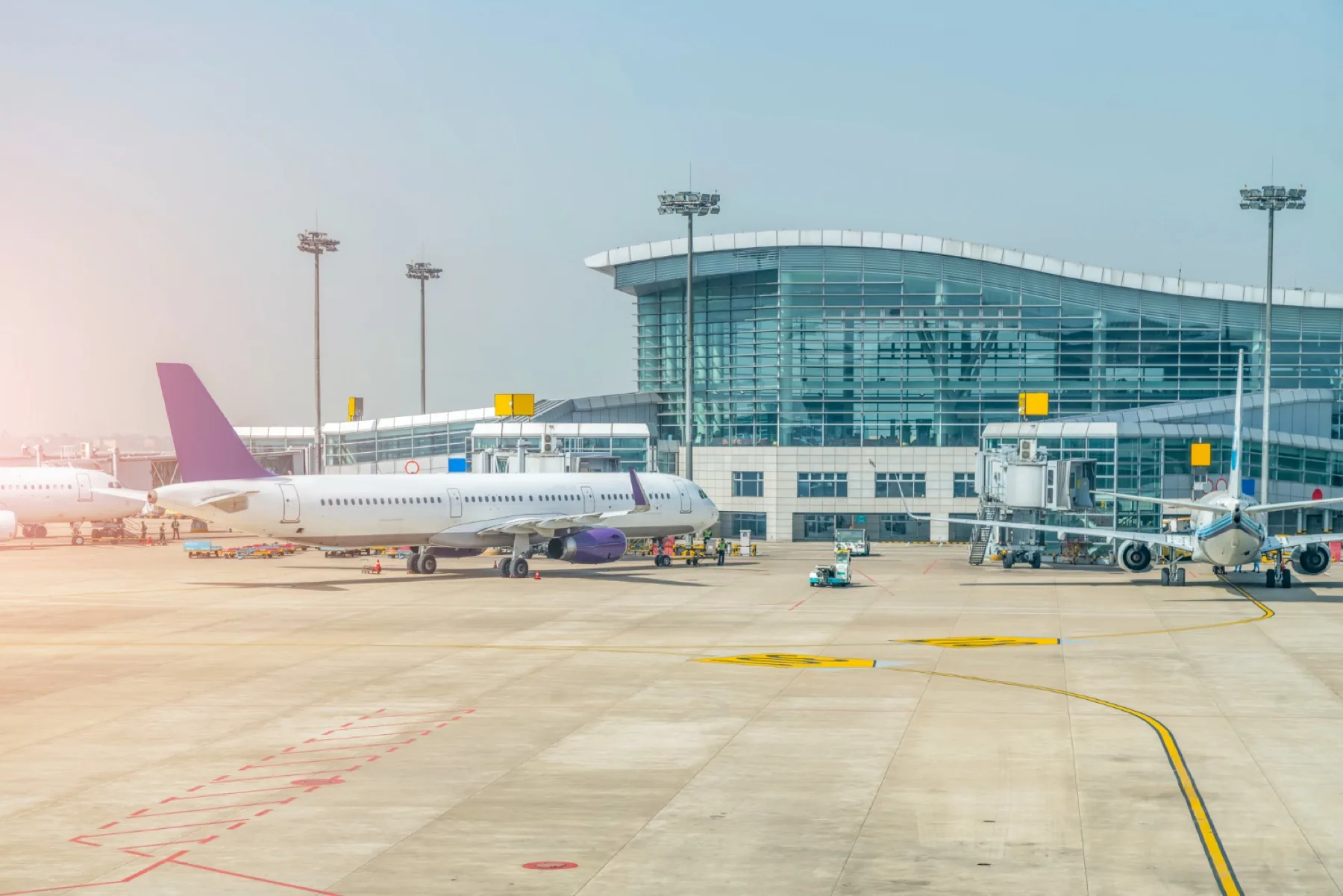
Understanding Algerian civil aviation begins with grasping its physical foundation: a network of airport terminals, runways, control towers, hangars and aprons spread across 2.38 million square kilometres. Algeria is, by area, the largest state in Africa and the Mediterranean. To this singular territory corresponds a dense, hierarchical and progressively modernised airport infrastructure, placed under the supervision of the National Civil Aviation Authority (ANAC) and operated mainly by the Airport Services Management Establishment (EGSA).
For an aviation maintenance industrial project such as AéroNéo Algeria, this panorama is not a backdrop: it is the nervous system on which the future MRO activity will anchor itself. This dossier proposes a reasoned mapping of Algerian airports, from international hubs to Saharan airfields, including oil-related platforms and regional airports of the north.
1. The aeronautical geography of Algeria: 35+ civil airports, 2.38 million square kilometres
Algeria has today more than 35 airports open to public air traffic, not counting military airfields, private corporate runways and restricted aerodromes linked to the hydrocarbons industry. This density reflects the combination of a Mediterranean coastline more than 1,600 kilometres long, a densely populated Tell foothill, extensive high plateaus, and a Sahara that covers roughly eighty-five per cent of the national territory.
The Algerian airport network can be read along three concentric circles:
- The international hubs of the north, articulated around Algiers, Oran, Constantine and Annaba, concentrating most international passenger and freight traffic.
- The regional platforms, mainly located on the Tell strip and the high plateaus, ensuring domestic connectivity and certain seasonal international links.
- The Saharan and oil-related airfields, which irrigate the deep south, support hydrocarbon operations and open up the wilayas of the great south.
This three-circle architecture takes its meaning from the country’s long history. The current grid inherits airfields built during the colonial period, large-scale post-independence equipment programmes, and modernisation works launched from the 2000s onwards under successive national development plans.
An underestimated climatic advantage
Algerian aeronautical geography has another, less visible but industrially decisive asset: the quality of its sky. The high plateaus and the Sahara offer one of the highest annual sunshine rates in the world, low atmospheric humidity and limited precipitation. These conditions are valuable for aviation operations in the broad sense: regularity of operations, low atmospheric corrosion on stored airframes, increased longevity of ground equipment.
2. The international hubs: Houari Boumédiène, Oran-Es Sénia, Constantine-Mohamed Boudiaf, Annaba
At the top of the Algerian airport hierarchy stand four international hubs, structuring the country’s opening to the world and concentrating most scheduled commercial traffic.
Algiers — Houari Boumédiène
Houari Boumédiène Airport in Algiers (ALG) is, by far, the country’s leading airport. Located some twenty kilometres east of the capital, it has two parallel runways of approximately 3,500 metres, equipped with precision landing aids. Its West Terminal, inaugurated in the late 2010s, is among the most modern on the African continent. It accommodates long-haul international traffic, African and Mediterranean regional links, and the bulk of major domestic services. It is also the main air-freight gateway.
Oran — Es Sénia (Ahmed Ben Bella)
The second pole of the country, Oran-Es Sénia / Ahmed Ben Bella Airport (ORN), serves the economic capital of western Algeria. Its main runway, more than 3,000 metres long, accepts without restriction all contemporary commercial aircraft, wide-bodies included. Its modernised terminal supports substantial international operations to the western Mediterranean, Europe and West Africa.
Constantine — Mohamed Boudiaf
Constantine-Mohamed Boudiaf Airport (CZL) plays a central role for the entire inland east of the country. Its runway, roughly 2,400 to 2,700 metres depending on configurations, is equipped with modern approach aids. Its recently renovated terminal embodies the national ambition to provide each major regional pole with an architectural and functional showcase worthy of its hinterland.
Annaba — Rabah Bitat
Finally, Annaba (AAE), on the eastern coast, completes the international-hub quartet. Its position between the port of Annaba, the El Hadjar industrial basin and the Tunisian border makes it a natural gateway for Euro-Mediterranean flows of the east. Its runway, around 3,000 metres, hosts both scheduled and seasonal services.
3. Northern platforms: Tlemcen, Béjaïa, Sétif, Batna, Biskra
Beyond the four hubs, northern Algeria is irrigated by a string of regional airports that structure the interior of the country. Each of these airfields corresponds to a population basin, a dominant economic activity and a distinctive cultural heritage.
- Tlemcen — Zenata (TLM), in the far west, serves a border city of Andalusian tradition and a major agricultural plain.
- Béjaïa — Soummam-Abane Ramdane (BJA), on the Kabyle coast, combines tourism, port functions and domestic links.
- Sétif — Aïn Arnat (QSF) has become, through the intensity of traffic to Europe and especially France, one of the busiest regional airports of the country.
- Batna — Mostefa Ben Boulaïd (BLJ) serves the capital of the Aurès and its hinterland.
- Biskra — Mohamed Khider (BSK), the eastern Saharan gateway, articulates regional traffic and seasonal services.
These platforms, often with runways of 2,400 to 3,000 metres, feature modern control towers and standardised airport services. They form the backbone of the domestic network.
4. The Saharan airfields: Tamanrasset, Djanet, Ghardaïa, El Goléa, Adrar, Timimoun
The Algerian Sahara would not be accessible without its network of Saharan airport terminals. Far from peripheral, this grid forms a genuine nervous system for the southern wilayas, where road distances are measured in thousands of kilometres.
- Tamanrasset — Aguenar (TMR), above 1,400 metres in altitude, serves the capital of the Hoggar and is one of the most strategic airports of the deep south. Its runway, around 3,600 metres, accommodates wide-body aircraft.
- Djanet — Tiska (DJG), in the heart of the Tassili n’Ajjer, hosts tourism, scientific and logistical traffic.
- Ghardaïa — Noumérat-Moufdi Zakaria (GHA), in the M’zab, articulates religious, commercial and regional traffic.
- El Goléa (ELG), a historic stage of the trans-Saharan crossing, retains a runway operable by light and medium commercial aviation.
- Adrar — Touat-Cheikh Sidi Mohamed Belkebir (AZR) serves the eponymous Saharan wilaya and plays a key role in connecting the Touat-Gourara.
- Timimoun (TMX), in the Gourara, completes the south-western grid.
Beyond their transport function, these Saharan terminals carry their own industrial advantage: exceptionally favourable climatic conditions for the storage and preservation of airframes. This is one of the geographic foundations on which the AéroNéo project rests.
5. Oil-and-gas platforms: Hassi Messaoud, In Salah, In Amenas, Hassi R’Mel
A specific category deserves to be isolated: airfields linked to the oil and gas industry. As one of the leading African producers of hydrocarbons, Algeria’s production basins are served by dedicated airports, sized for crew rotations, technical freight and certain special operations.
- Hassi Messaoud — Oued Irara-Krim Belkacem (HME), Algeria’s oil capital, features a long runway and infrastructure dedicated to industrial air transport. It is one of the busiest airports of the south in terms of aircraft movements.
- In Salah (INZ), at the heart of the eponymous gas field, articulates technical traffic and logistical functions.
- In Amenas — Zarzaïtine (IAM), in the far south-east, serves one of the largest gas complexes of the country.
- Hassi R’Mel — Tilrempt (HRM), sharing its name with the largest regional gas field, plays a central role for the energy industry.
These platforms attest to a reality: Algeria has learned, over decades, to operate, maintain and service aeronautical infrastructure under the most demanding conditions — extreme heat, isolation and operational constraints specific to the hydrocarbons sector.
6. Infrastructure operated by EGSA
The operation of Algerian airport terminals is mainly handled by the Airport Services Management Establishment (EGSA), historically organised in three regional entities: EGSA Algiers, EGSA Oran and EGSA Constantine. Each coordinates the operation of a portfolio of airports corresponding to a major territorial frontage.
EGSA’s missions encompass:
- Terminal operations: passenger handling, security, cleanliness, signage, counter management.
- Ground handling at many platforms: check-in, baggage, ramp operations.
- Infrastructure maintenance: runways, taxiways, lighting, backup power.
- Commercialisation of airport space: retail, food and beverage, lounges.
- Liaison with the authorities: aviation regulators and institutional partners.
EGSA is not a competitor of the future Algerian MRO ecosystem — quite the opposite: it is a natural institutional partner whose detailed knowledge of the field, of procedures and of operational constraints is precious for any industrial project anchored on an airport platform.
7. The role of ANAC: oversight, certification, supervision
Above operational operators stands the regulator: the National Civil Aviation Authority (ANAC). In line with Algeria’s commitments under the Chicago Convention (ICAO), ANAC is responsible for implementing international standards on national territory.
Its missions include:
- The certification of aerodromes and the continuous supervision of their compliance with the relevant ICAO annexes.
- The certification of air operators (AOC) as well as maintenance organisations (Part-145 equivalents), training centres and continuing-airworthiness management organisations.
- The issuance and oversight of personnel licences for crew and technical staff.
- The safety of civil aviation and coordination with security authorities.
- The representation of Algeria in international fora: ICAO, African and Arab civil-aviation organisations.
For a next-generation MRO project, ANAC is the central counterpart: it will deliver, in due time, the maintenance-organisation approvals and supervise their continued validity.
8. Current capacities: runways, lengths, ILS, services
The following table summarises the approximate characteristics of the ten leading Algerian civil airports. Runway lengths are drawn from aeronautical information publications and are indicative; they may evolve in line with ongoing modernisation programmes.
| Airport | City / wilaya | IATA code | Main runway length |
|---|---|---|---|
| Houari Boumédiène | Algiers | ALG | ≈ 3,500 m |
| Es Sénia / Ahmed Ben Bella | Oran | ORN | ≈ 3,000 m |
| Mohamed Boudiaf | Constantine | CZL | ≈ 2,700 m |
| Rabah Bitat | Annaba | AAE | ≈ 3,000 m |
| Aguenar | Tamanrasset | TMR | ≈ 3,600 m |
| Oued Irara-Krim Belkacem | Hassi Messaoud | HME | ≈ 3,500 m |
| Aïn Arnat | Sétif | QSF | ≈ 3,000 m |
| Soummam-Abane Ramdane | Béjaïa | BJA | ≈ 2,400 m |
| Noumérat-Moufdi Zakaria | Ghardaïa | GHA | ≈ 3,000 m |
| Touat-Cheikh Sidi Mohamed Belkebir | Adrar | AZR | ≈ 3,000 m |
The vast majority of these airports are equipped with landing aids (ILS, VOR/DME, precision lighting), aeronautical weather services, fuel-uplift capacity and standardised ground handling. Several of them can host, without restriction, wide-body aircraft of the A330/A350 or B777/B787 family.
9. The Algerian airport modernisation programme
Since the early 2000s, Algeria has launched successive airport modernisation programmes, integrated into the major national public-investment plans. Their structural axes include:
- The renovation or reconstruction of passenger terminals in most major cities: Algiers (West Terminal), Oran, Constantine, Annaba, Tlemcen, Béjaïa, Biskra and Hassi Messaoud, among others.
- The upgrade of runways and aprons to accommodate the most recent generations of commercial aircraft.
- The deployment of navigation and surveillance aids compliant with ICAO standards, together with the air navigation services.
- The digitalisation of airport processes: check-in, border control, baggage tracking and operations supervision.
- The strengthening of security in line with the relevant annexes of the Chicago Convention.
This long-term movement reflects a clear political ambition: to make Algerian terminals international-grade infrastructure, capable of hosting not only scheduled traffic but also adjacent industries — freight, MRO, conversion and recycling.
10. AéroNéo’s positioning: a site projected in southern Algeria
AéroNéo Algeria is, at this stage, an industrial project in pre-launch. The selected site, located in southern Algeria, is subject to a concession process under way with the competent authorities. The official name of the platform will be communicated once the concession is awarded.
The choice of a Saharan site responds to a precise industrial rationale:
- A dry climate, weakly corrosive, particularly suited to long-term storage and airframe preservation.
- An exceptional sunshine resource, opening the way to partially solar energy supply.
- A large-scale available land base, indispensable for hosting hangars, parking aprons, workshops and recycling areas.
- An immediate proximity to an existing airport terminal — and thus to a runway, a tower, lighting and a ready operational environment.
- An industrial ecosystem nourished by southern energy infrastructure and by local technical skills.
“Heavy maintenance of an aircraft does not travel with an airline: it is built around a terminal, a runway and a territory. That is the whole point of AéroNéo Algeria.”
11. Complementarities: MRO, existing terminal and industrial ecosystem
Anchoring an MRO workshop to an existing terminal is not a detail: it is a structuring principle of the maintenance economy. Several consequences follow.
Mutualisation of aeronautical infrastructure
The runway, lighting, control tower, navigation aids, fire-fighting and perimeter security already exist: the MRO workshop does not duplicate them; it uses them under access rules agreed with the operator and the authority.
Tight logistics integration
Spare parts, special equipment, calibrated tooling and high-value components transit through the existing terminal. This requires adapted customs flows, climate-controlled warehouses and a rigorous downstream supply chain.
A shared-services ecosystem
Fuel, electric power, water, accommodation for technical crews, hotel capacity for foreign inspectors and auditors: so many services that are pooled between traditional airport activity and MRO activity.
12. Outlook 2030+: capacity, projected traffic, continental hub
By 2030 and beyond, several major trends are taking shape for Algerian airport infrastructure:
- A sustained growth in passenger traffic, driven by national demographics, the gradual opening of new African links and the development of Saharan tourism.
- A reinforcement of air freight, in line with the industrialisation of southern wilayas and the rise of logistics zones.
- A scaling up of MRO and P2F-conversion activities, consistent with the objectives of industrial diversification.
- A positioning of Algeria as a continental hub, at the junction of Europe, West Africa, the Sahel and the Middle East.
- An increased integration of sustainability: renewable energy, water management, end-of-life aircraft recycling to the most demanding international standards.
Along this trajectory, the Algerian airport network is not a mere backdrop — it is the physical foundation on which the next decade of national civil aviation will be built. AéroNéo Algeria intends to be one of the emblematic industrial actors of that decade, in service of a renewed African technical sovereignty.